You are in: - www.laryngograph.com/products/portable.htm
 |
 |
 |
|
|
Speech
production and perception tools for real-time assessment, analysis and
therapy
|
|||
You are in: - www.laryngograph.com/products/portable.htm
| |
|
|
|
|
Speech
production and perception tools for real-time assessment, analysis and
therapy
|
|||
|
PORTABLE
ELECTRO-LARYNGOGRAPH
|
|
|
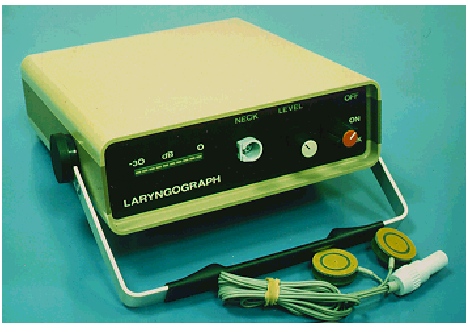
The portable, rechargeable, electro-laryngograph shown in the photograph is a well established instrument which makes it possible to examine vocal fold contact during voice production without interfering with the processes of speaking or singing. Monitoring is by means of two gold plated, guard-ring electrodes which are lightly placed on the surface of the speaker’s neck at the level of the thyroid cartilage. The electro-laryngograph circuit automatically adjusts itself to the speaker, and simply by placing the electrodes in position the output waveform, Lx, can be displayed, recorded — even on an ordinary cassette — and used for quantitative analysis.
The contact phase of vocal fold vibration is the most important speech aspect of larynx activity since it determines voice pitch, quality and regularity. “Laryngographs” of our manufacture are in use all over the world as aids to diagnosis in voice pathology, for patient records, and in speech therapy - where visual feedback is especially effective. The information provided by the electrolaryngograph has the advantage that it is unaffected by acoustic noise, so Lx waveforms can be usefully obtained and displayed in what would otherwise be quite adverse clinical and industrial conditions. |
|
|
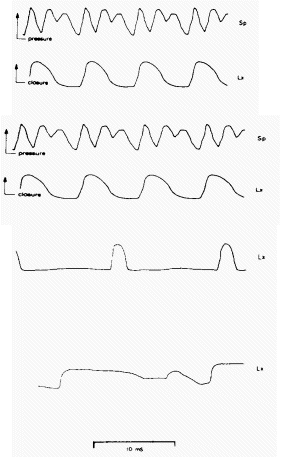
Electro-laryngograph Outputs The two waveforms shown on the right are for a normal adult male voice. Sp is the speech pressure waveform obtained acoustically, Lx is the simultaneously recorded output from the electro-laryngograph. Lx normally gives information about the contact, separation and open phases of vocal fold vibration. Closure corresponds to the sharp upward step in the Lx waveform, maximum vocal fold contact occurs when Lx is at its peak The slower separation of the vocal folds is shown by the shallow curve leading to the flat trough in Lx - which relates to the open phase. This Lx waveform comes from the same normal speaker producing a breathy voice quality. Each vocal fold closure is shown by a small peak indicating relatively brief vocal fold contact. The long separation between peaks corresponds to a long open phase. The last Lx waveform shown is from the same speaker as above producing creaky voice. One laryngeal cycle is shown with two main, sharply defined closures. Vocal fold contact is maintained for a large part of the irregular period in this voice quality and the small secondary peak of closure is quite typical. These aspects of normality are of great use in the interpretation of pathological conditions and in guiding a return to normality. |
 |
|
|
|
| Output voltage range | 6V p p maximum down to 4OmV p p noise |
| Output impedance | 150 Ohms |
| Bandwidth | +/- 0.5dB between 10Hz & 5kHz |
| Signal to noise ratio | Depending on speaker about 30 to 40 dB |
| Internal voltage levels | +/-3V to +/-4.5V |
| Power source | PP9 size rechargeable Nickel-Cadmium battery 8.4V/12AH |
| Use with one charge | 24 hours of continuous use |
| Battery check indicator | Provided by bar display |
| Output level indicator | 30dB range bar display |
| Output level control | via a linear control |
| Patient isolation is sufficient for the most rigorous clinical application – electro-cochlear stimulation for example | |
| Size | 1.4 Kg; 24cmD x 25cmW x 9cmH overall |
| Safety | Complies with BS5724 and IEC601-1 Class 1 Type BF |
|
Publications describing work using the Laryngograph 1971 Fourcin, A J and Abberton, E: First applications of a new laryngograph, in Medical and Biological Illustration, 21, pp 172-182 (see also Volta Review, 74, 3, pp 16 1-176, 1972, and in J M Pickett, H Levitt and R A Houde (eds Sensory Aids for the Hearing Impaired, 1980, New York J Wiley, pp 376-386) 1974 Fourcin, A J: Laryngographic examination of vocal fold vibration, in B Wvke (ed) Ventilatory and Phonatorv Control Systems, London OUP. pp 315-333. 1976 Fourcin, A J and Abberton, E: The Laryngograph and Voiscope in speech therapy, E Loebell (ed) Proceedings of the XVI International Congress of Logopaedics and Phoniatrics, Basel S Karger, pp 116-122 1981 Fourcin, A J: Laryngographic assessment of phonatorv funcuon, in C L Ludlow (ed) Conference on the Assessment of Vocal Pathology, Maryland ASHA Reports 11. 1981Leff, J and Abberton, E: Voice pitch measurements in schizophrenia and depression, Psychological Medicine, 11, pp 849-852 1981 Rosen, S M, Fourcin, A J and Moore, B C J: Voice pitch as an aid to lipreading, Nature, 291, no 5811, pp 150-152 1981 Berry, R J, Epstein, R, Freeman, M, MacCurlain, F and Noscoe, N: An objective analysis of voice disorder, Part 2 British Journal of Disorders of Communicanon, Vol 17, 1, pp 77-83. 1982 Berry. R J, Epstein, R, Fourcin A J, Freeman, M, MacCurtain. F, and Noscoe, N: An objective analysis of voice disorder, Par 1. British Journal of Disorders of Communication, Vol 17, 1, pp 67-76. 1983 Fourcin, A J, Douek, E E, Moore, B C J, Rosen, S M, Walliker, J R, Howard, D M, Abberton, E and Frampton, S: Speech perception with promontory stimulation. In Proceedings of the New York Academy of Sciences’ International Cochlear Prosthesis Conference, April 1982, Annals of the New York Academy of Sciences, Vol 405, pp 280-294. 1983 Abberton, E and Fourcin, A J: Electrolaryngography In C Code and M Ball (eds) Clinical Phonetics. London. Croom Helm |

|
No. 1 F o u n d r y M e w s , L o n d o n N W 1 2 P E U n i t e d K i n g d o m T e l : + 4 4 2 0 7 3 8 7 7 7 8 9 F a x : + 4 4 2 0 7 3 8 3 2 0 3 9 l x @ l a r y n g o g r a p h . c o m |